Mar 2026 • Medium
You Don’t Think You’re a Defense Contractor. The DoD Disagrees.
A practical guide to determining CMMC applicability, with real-world and out-of-the-box scenarios.
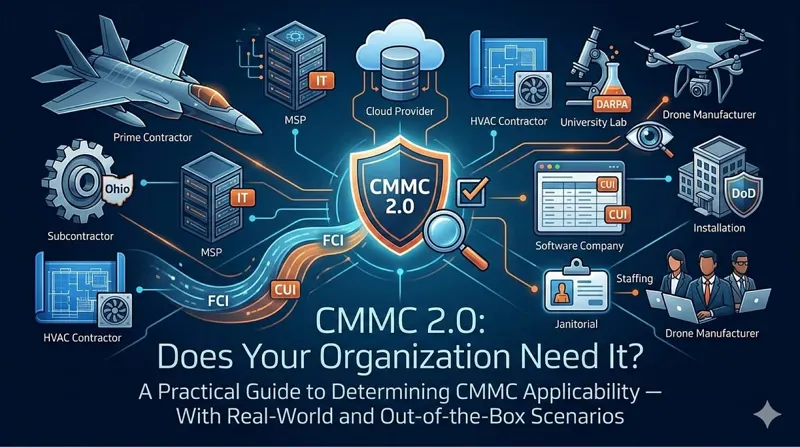
The Cybersecurity Maturity Model Certification (CMMC) 2.0 program is no longer a “wait and see” proposition. As of November 10, 2025, the Department of Defense’s final acquisition rule (48 CFR Parts 204, 212, 217, and 252) went live, embedding CMMC requirements directly into DFARS contract clauses. Contracting officers are now actively inserting CMMC language into solicitations. If your organization touches the DoD supply chain in any way, the clock is ticking.
But here’s the thing most articles won’t tell you: the question of whether you need CMMC isn’t always straightforward. Sure, if you’re Lockheed Martin or Raytheon, the answer is obvious. But what about the HVAC company that services a military base? The cloud storage vendor that a defense subcontractor uses? The university research lab partnering with DARPA? The commercial software company whose product happens to be installed on a Navy destroyer?
This article walks you through the decision-making process in plain English, gives you concrete examples of organizations that clearly need CMMC, and then pushes into “out-of-the-box” territory — those scenarios where applicability gets murky and the stakes get high if you guess wrong. And when the time comes to move from “do I need this?” to “how do I get certified?”, we’ll explain why choosing the right Certified Third-Party Assessment Organization (C3PAO) matters just as much as the compliance work itself — and why organizations across the defense industrial base are turning to Schellman.
What Is CMMC 2.0? A Quick Refresher
CMMC stands for Cybersecurity Maturity Model Certification. It’s the DoD’s framework for ensuring that every organization in its supply chain meets a verifiable standard of cybersecurity hygiene. Before CMMC, defense contractors were supposed to self-attest to NIST SP 800-171 compliance under DFARS 252.204-7012. The problem? Self-attestation was an honor system, and the DoD found that an alarming number of contractors were either non-compliant or had significantly overstated their cybersecurity posture. According to the 2025 State of the DIB Report, while 69% of contractors claimed DFARS compliance through self-assessment, only about 30% had completed the kind of rigorous assessment that would actually validate their security controls.
CMMC fixes this by requiring verified assessments at three escalating levels.
The Three CMMC Levels
Level 1 — Basic Safeguarding of FCI. Requires 17 basic security practices based on FAR 52.204-21. Assessment method: annual self-assessment, with results posted to SPRS.
Level 2 — Protection of CUI. Requires compliance with 110 security requirements from NIST SP 800-171. Assessment method: self-assessment *or* C3PAO third-party assessment, depending on what the solicitation specifies. C3PAO assessments are valid for three years with annual affirmation of continuous compliance.
Level 3 — Higher-Level Protection Against Advanced Persistent Threats. Includes all Level 2 requirements plus 24 additional controls from NIST SP 800-172. Assessment method: government-led DIBCAC assessment. Reserved for the most sensitive programs.
For organizations requiring a Level 2 C3PAO assessment, the assessor you choose will have a direct impact on the quality, efficiency, and defensibility of your certification. Not all C3PAOs are created equal — a point we’ll return to later in this article.
Key Terms You Need to Understand
Before we get into specific scenarios, let’s make sure we’re speaking the same language. Two terms drive the entire CMMC applicability question.
Federal Contract Information (FCI): This is non-public information provided by or generated for the government under a contract. Think of it as anything that’s not meant for public release but isn’t classified. It could be contract performance reports, organizational charts related to a DoD project, internal pricing proposals, or even email threads about contract logistics. If the government gave it to you, or you created it for the government under contract, it’s probably FCI.
Controlled Unclassified Information (CUI): CUI is a step above FCI. It’s information that requires safeguarding or dissemination controls pursuant to law, regulation, or government policy — but is not classified. Examples include technical drawings for military components, export-controlled data (ITAR/EAR), critical infrastructure security information, vulnerability assessments, personally identifiable information of military personnel, and proprietary research results generated under a DoD-funded project.
The bottom line: if you handle FCI, you’re looking at Level 1 at minimum. If you handle CUI, it’s Level 2 or 3. If you handle neither, CMMC does not apply to you.
The CMMC Decision Framework: Five Questions to Ask
Here’s a straightforward framework to determine whether CMMC applies to your organization.
1. Do you currently hold, or are you bidding on, a contract with the U.S. Department of Defense? If yes, CMMC almost certainly applies unless you exclusively provide commercial off-the-shelf (COTS) items with zero modification.
2. Are you a subcontractor to a company that holds a DoD contract? Prime contractors are required to flow CMMC requirements down to subcontractors at all tiers who handle FCI or CUI. Don’t assume you’re exempt just because you’re three levels removed from the DoD.
3. Does your organization store, process, or transmit FCI or CUI? This is the critical trigger. It doesn’t matter whether you think of yourself as a “defense contractor.” If DoD data flows through your systems, you’re in scope.
4. Does your contract contain DFARS 252.204-7012 or the new 252.204-7021/7025 clauses? The presence of these clauses in your contract or subcontract is a dead giveaway. If 7012 is in there, CMMC requirements are coming (or already here).
5. Do you provide services to a DoD contractor that involve access to their IT systems or data? Managed IT providers, cloud hosting companies, HR software vendors — if your platform touches or stores CUI on behalf of a defense contractor, CMMC requirements may flow down to you.
If you answered “yes” to any of these questions, you should be actively evaluating your CMMC obligations. Now let’s look at this in practice.
Clear-Cut Examples: Organizations That Definitely Need CMMC
These are the obvious cases. If your organization resembles any of these, stop reading and start preparing.
1. The Defense Prime Contractor
A company that holds direct contracts with the DoD to manufacture fighter jet avionics systems. They receive technical data packages containing CUI, they process engineering change orders with export-controlled data, and they report directly to DoD program offices.
CMMC Level Required: Level 2 (C3PAO assessment) at minimum, likely Level 3 for advanced programs.
Why: They handle CUI daily. The solicitations on these contracts will explicitly require CMMC compliance.
2. The Machine Shop Subcontractor
A 50-person precision machining company in Ohio that makes turbine blade components for a Tier 1 defense supplier. They receive technical drawings marked as CUI and coordinate with the prime contractor via email containing controlled technical data.
CMMC Level Required: Level 2.
Why: The prime contractor is obligated to flow down CMMC requirements. This shop handles CUI on its information systems. Size doesn’t matter — the DoD’s Defense Contract Management Agency conducts random assessments regardless of company size.
3. The IT Managed Services Provider (MSP)
A regional IT services firm manages the network, email system, and endpoint security for several defense contractors. Their technicians have administrative access to systems that store CUI.
CMMC Level Required: Level 2.
Why: Even though they don’t create CUI, their administrative access to systems containing CUI puts them squarely in scope. They are processing and potentially storing CUI as part of their service delivery. Their clients’ CMMC assessors will want to see the MSP’s compliance posture.
4. The Cloud Service Provider
A SaaS company provides a project management platform used by a defense contractor to track milestones on a DoD program. Users upload CUI documents, share CUI data in task descriptions, and collaborate on controlled technical information within the platform.
CMMC Level Required: Level 2 (or must meet FedRAMP Moderate equivalent).
Why: CUI is stored, processed, and transmitted within their cloud environment. They are a critical node in the data flow and must demonstrate equivalent security controls. This is an area where Schellman’s dual expertise as both a FedRAMP 3PAO and a CMMC C3PAO is particularly valuable — organizations operating in cloud environments often need to satisfy overlapping requirements across both frameworks, and working with an assessor who understands both eliminates costly misalignment.
Out-of-the-Box Scenarios: The Cases Nobody Talks About
This is where it gets interesting. The following examples represent real-world situations where CMMC applicability catches organizations off guard. These are the conversations happening across the defense industrial base every day, and the answer is rarely as simple as people expect.
Scenario A: The HVAC Contractor That Services a Military Installation
Acme Mechanical Services has a DoD facilities contract to maintain HVAC systems at a military base. They receive building blueprints, access schematics of critical infrastructure, and their technicians have base access credentials.
Do they need CMMC? Very likely yes.
The building layouts and infrastructure schematics for a military installation are almost certainly CUI. Even if Acme’s leadership thinks of themselves as “just an HVAC company,” the data they’re handling isn’t just about ductwork — it’s about the physical security posture of a federal facility. If that data is on their laptops, in their email, or on a shared drive back at the office, CMMC Level 1 or Level 2 applies depending on how the data is categorized.
The Gotcha: Many facilities and construction contractors have never thought about cybersecurity compliance because they don’t consider themselves “tech companies.” But the data is the data, regardless of your industry.
Scenario B: The University Research Lab
A major research university has a $5 million DARPA-funded research contract studying advanced materials for next-generation body armor. The principal investigator and a team of graduate students conduct research, publish findings (with DoD approval), and store research data on university servers.
Do they need CMMC? Yes, and this is a massive blind spot in higher education.
Research data generated under a DoD contract is typically CUI. The university’s information systems that store and process this data must meet CMMC Level 2 requirements. This creates enormous challenges for universities, because their open, collaborative IT environments are fundamentally at odds with the segmentation and access control requirements of NIST SP 800-171.
The Gotcha: Many universities try to argue that their research is “fundamental research” exempt from CUI controls. In some cases, they’re right. But the moment the contract includes DFARS 7012 or specifies export-controlled deliverables, that argument falls apart. Universities with significant DoD research portfolios need dedicated CUI enclaves and should be actively pursuing CMMC certification for those environments.
Scenario C: The Foreign-Owned Supplier
A German precision optics manufacturer supplies lenses and targeting components to a U.S. defense prime. They receive technical specifications containing CUI, manufacture the components at their facility in Stuttgart, and ship finished products to the U.S. for integration into weapons systems.
Do they need CMMC? Yes — and international applicability is one of the most underappreciated aspects of CMMC.
CMMC requirements flow down through the supply chain regardless of geography. If this German company handles CUI under a DoD subcontract, they need CMMC certification. The Cyber AB is working to establish international assessment capabilities, but foreign companies face additional challenges around data sovereignty, ITAR restrictions, and finding qualified C3PAOs willing to conduct overseas assessments.
The Gotcha: This is an area where many international suppliers are completely unprepared. If you’re a U.S. prime contractor relying on foreign suppliers for critical components, you need to be having these conversations now — or risk supply chain disruptions when those suppliers can’t meet CMMC requirements.
Scenario D: The Commercial Software Company With One DoD Customer
A commercial software company builds an enterprise resource planning (ERP) platform used by thousands of customers across industries. One of their customers happens to be a defense contractor who uses the platform to manage production scheduling for DoD contracts. CUI data fields exist within the ERP environment for this single customer.
Do they need CMMC? It depends, and this is where scoping becomes critical.
If the software company hosts the application and CUI resides on their infrastructure, they are almost certainly in scope. However, if the defense contractor hosts the application on-premise within their own CUI boundary, the software company may be able to argue they are out of scope because CUI never touches their systems. The key question is: where does the data live, and who has access to it?
The Gotcha: Even if CUI doesn’t reside on the software company’s servers, if their support engineers can access the defense contractor’s instance (via remote support, admin tools, or logging), they may still be in scope. Companies in this situation should work with their legal and compliance teams to draw clear boundaries around CUI access.
Scenario E: The Janitorial Company With Base Access
A janitorial services company holds a contract to clean offices at a DoD agency. Their employees have facility access badges and enter secured spaces after hours.
Do they need CMMC? Probably Level 1, possibly not at all — but it’s not automatic.
If the janitorial company’s contract generates FCI (invoices, access rosters, performance reports provided by or generated for the government), then Level 1 applies. If their employees could physically access areas where CUI is stored or displayed, the situation becomes more complex from a physical security standpoint, even though CMMC is primarily focused on information system controls.
The Gotcha: The real risk here is that the contract itself may contain DFARS clauses the janitorial company’s leadership never noticed. Always read your contracts — every clause. If DFARS 7012 is buried in the terms, CMMC compliance is coming whether you expected it or not.
Scenario F: The Staffing Agency Placing Contractors at Defense Firms
A staffing agency places engineers and IT professionals at defense contractors. These temporary workers handle CUI daily in their assigned roles. The staffing agency handles the workers’ HR data, payroll, benefits, and onboarding documentation.
Do they need CMMC? This is a gray area, but the trend is toward yes.
The staffing agency itself may not directly handle CUI. However, they process FCI (contract documents, task orders from the defense contractor, performance evaluations). Additionally, if the staffing agency’s onboarding process involves providing workers with accounts or credentials that grant access to the defense contractor’s CUI environment, the agency could be considered part of the information system boundary.
The Gotcha: Smart prime contractors are beginning to require CMMC compliance from their staffing vendors as a contractual condition, regardless of the technical applicability debate. If you’re in the staffing business and you serve the defense industry, getting ahead of this is a competitive advantage.
Scenario G: The Logistics and Shipping Company
A third-party logistics provider handles warehousing and shipping for a defense contractor. They receive shipping manifests that describe military components, handle packaging with CUI markings, and use an inventory management system that tracks controlled items.
Do they need CMMC? Very likely yes for Level 1, potentially Level 2.
Shipping manifests and inventory data for controlled military components typically constitute FCI at minimum and could be CUI depending on the classification of the items being shipped. If the logistics provider’s information systems contain data about what’s being shipped, where it’s going, and in what quantities — especially for sensitive military equipment — they’re handling information the DoD wants protected.
The Gotcha: Logistics companies often operate on thin margins and may not have dedicated IT security staff. The cost of CMMC compliance can be a significant burden, but the alternative is losing defense logistics contracts entirely.
Scenario H: The Commercial Drone Manufacturer
A company builds commercial drones primarily for agricultural and real estate industries. A defense contractor approaches them to provide modified drones for surveillance applications under a DoD contract. The defense contractor shares specifications that include CUI-marked performance requirements and operating parameters.
Do they need CMMC? Yes, the moment they accept that subcontract.
This is a common scenario as the DoD increasingly looks to commercial technology companies for innovative solutions. The drone manufacturer may have zero experience with defense compliance, but the instant they receive CUI under a DoD subcontract, they’re in the CMMC ecosystem. Their commercial IT environment — probably a mix of cloud services, personal devices, and consumer-grade security — is now expected to meet NIST SP 800-171 standards.
The Gotcha: Commercial tech companies chasing their first DoD deal often dramatically underestimate the compliance burden. The revenue from that defense contract needs to justify not just the direct costs, but also 6-12 months of preparation time and potentially $100,000+ in compliance infrastructure, assessment fees, and ongoing maintenance.
Scenario I: The Law Firm Representing a Defense Contractor
A major law firm provides legal counsel to a defense contractor on matters involving DoD contract disputes. In the course of representation, the law firm receives and stores documents containing CUI on its internal systems — technical data relevant to the dispute, internal communications about CUI handling, and contract documentation.
Do they need CMMC? Technically, CMMC applies to contractors and subcontractors, not to legal counsel in the traditional sense. But the reality is more nuanced.
While law firms are generally not “contractors” under DFARS, if they are handling CUI and are operating under a contract or agreement that flows down CUI protection requirements, they may be expected to meet equivalent security standards. More practically, defense contractor clients are increasingly requiring their outside counsel to demonstrate NIST SP 800-171 compliance as a condition of engagement. CMMC certification, while not contractually mandated for the law firm, becomes a market differentiator and a signal of trustworthiness.
The Gotcha: The legal industry is notorious for lagging behind on cybersecurity. Law firms that serve the defense sector should at minimum align their information security practices with NIST SP 800-171 and consider voluntary CMMC Level 2 certification as a business development advantage. Schellman regularly works with professional services firms — including legal and financial institutions — across its ISO 27001 and SOC 2 practices, making the transition to CMMC a natural extension for these organizations.
Scenario J: The Company That “Only Provides COTS Products”
A company sells commercially available networking equipment to the DoD. They sell the same product to hospitals, banks, and retail chains. They argue they’re exempt because COTS providers are excluded from CMMC.
Do they need CMMC? Maybe not — but the COTS exemption is narrower than most companies think.
Under FAR 2.101, a COTS item must be offered to the government without any significant modifications. The moment the DoD asks for custom firmware, a specific security configuration, modified hardware, or a tailored version of the product, it is no longer COTS. Additionally, if the contract involves professional services (installation, integration, ongoing support) alongside the product sale, those service components may independently trigger CMMC requirements because they generate FCI.
The Gotcha: Companies love to claim COTS exemption because it sounds like a free pass. But the exemption is based on the product as delivered, not the product as designed. Any customization for the DoD — even minor configuration changes — can invalidate the COTS designation. Consult with a compliance attorney before relying on this exemption.
The Phased Implementation Timeline
Understanding when CMMC will affect your contracts is just as important as knowing whether it applies. The DoD is rolling CMMC out in four phases.
Phase 1 (Nov 10, 2025 — Nov 10, 2026): CMMC Program Office has discretion in selecting contracts requiring Level 1 or Level 2 self-assessments. DoD may also require C3PAO assessments in select solicitations.
Phase 2 (Nov 10, 2026 — Nov 9, 2027): Solicitations and contracts may require Level 2 C3PAO assessments where applicable. This is the date most contractors are circling in red.
Phase 3 (Nov 10, 2027 — Nov 9, 2028): Level 2 C3PAO assessments and Level 3 DIBCAC assessments may be required for higher-sensitivity programs.
Phase 4 (Nov 10, 2028 onward): Full enforcement. All DoD contracts (except pure COTS) require appropriate CMMC level as a condition of award. No exceptions, no waivers, no grace periods.
Critical Insight: Don’t let the phased rollout create a false sense of security. Contracting officers have discretion to require CMMC in any solicitation starting in Phase 1. And most organizations need 6-12 months to prepare for an assessment. If you wait until your contract specifically demands it, you’re already behind. C3PAOs are in high demand, and assessment scheduling becomes increasingly competitive as each phase goes live.
The False Claims Act: The Hidden Enforcement Mechanism
Here’s something that should keep every defense contractor’s leadership team awake at night: CMMC compliance isn’t just about winning contracts. It’s about legal liability.
When you bid on a DoD contract, you affirm your compliance with the required CMMC level. If that affirmation is inaccurate — whether intentionally or through willful ignorance — the Department of Justice can pursue action under the False Claims Act (FCA). The FCA provides for treble damages plus per-claim penalties.
The DOJ has already signaled aggressive intent in this area. Their Civil Cyber-Fraud Initiative (CCFI), launched in October 2021, explicitly targets organizations that falsely certify cybersecurity compliance in connection with government contracts. In February 2025, the DOJ announced an $11 million settlement with a defense contractor that falsely certified its cybersecurity compliance.
The message is clear: if you say you’re compliant and you’re not, the consequences go far beyond losing a contract. You’re looking at potential fraud liability.
This is precisely why working with a credible, experienced C3PAO matters. A thorough, defensible assessment from a firm like Schellman provides your organization with documented evidence that your certification is legitimate. It’s not just about passing — it’s about being able to demonstrate to the DOJ, DIBCAC, or your prime contractors that your compliance was verified by one of the most rigorous assessment organizations in the market.
Voluntary CMMC Adoption: Why Some Companies Pursue It Without Being Required
Not every organization that pursues CMMC certification is contractually required to do so. There are several strategic reasons a company might voluntarily seek certification.
Market Expansion: Companies that don’t currently serve the DoD but want to break into defense work can use CMMC certification as a credential that immediately signals readiness to prime contractors looking for compliant supply chain partners.
Competitive Differentiation: In industries adjacent to defense (aerospace, critical infrastructure, energy), CMMC certification can serve as a trust signal that differentiates your organization from competitors who can’t demonstrate equivalent security maturity.
Framework Alignment: Organizations already aligned with NIST SP 800-171 (perhaps due to other regulatory requirements) may find that CMMC certification is a relatively small incremental effort that yields significant business development returns. If you’re already working with Schellman on a SOC 2 examination or ISO 27001 certification, adding CMMC to your compliance portfolio through the same assessor is a natural and cost-efficient next step.
Insurance and Risk Management: Some cyber insurance carriers are beginning to recognize CMMC certification as a positive indicator of security maturity, which may translate into more favorable policy terms.
Proactive Positioning: Given the trend toward broader federal cybersecurity mandates (not just DoD), organizations that achieve CMMC certification today are better positioned for whatever compliance frameworks emerge from other federal agencies.
Practical Next Steps: What To Do Right Now
If this article has you thinking your organization might be in scope for CMMC, here’s what to do.
Review Your Contracts. Pull every DoD contract and subcontract you hold. Search for DFARS 252.204-7012, 252.204-7021, and 252.204-7025 clauses. If any of these are present, CMMC applies.
Map Your Data Flows. Identify where FCI and CUI enter your organization, where they’re stored, where they’re processed, and where they go. This is the foundation of your scoping exercise.
Talk to Your Primes. If you’re a subcontractor, reach out to your prime contractors and ask them directly: “What CMMC level do you expect us to achieve, and on what timeline?” Don’t wait for them to come to you.
Get a Gap Assessment. Engage a Registered Provider Organization (RPO) or a CMMC consultant to conduct a readiness assessment against NIST SP 800-171. This will give you a realistic picture of where you stand and what work lies ahead.
Build Your System Security Plan (SSP) and POA&M. Document your current security posture in a System Security Plan and create a Plan of Action and Milestones for any gaps. These documents are foundational to the CMMC assessment process.
Budget for It. CMMC compliance is not free. Depending on your current maturity, expect to invest in technology upgrades, policy development, staff training, and assessment fees. For a small to mid-size company, total costs to reach Level 2 can range from $50,000 to over $500,000 depending on the starting point.
Engage Your C3PAO Early. Don’t wait until your remediation is complete to start the conversation with your C3PAO. Firms like Schellman can help you understand the assessment process, set realistic timelines, and ensure you’re preparing the right evidence. With C3PAO demand increasing as Phase 2 approaches, booking your assessment window early is a strategic move.
Think Beyond CMMC. If your organization also needs SOC 2, FedRAMP, ISO 27001, or other compliance certifications, consider working with a single assessor that can deliver multiple certifications through an integrated approach. This is where Schellman’s breadth of capabilities offers a tangible advantage in cost savings, efficiency, and consistency.
Conclusion
CMMC is not just another acronym in the alphabet soup of federal compliance. It’s a fundamental shift in how the Department of Defense enforces cybersecurity across its supply chain. Whether you’re a massive prime contractor, a 10-person machine shop, a university research lab, or a commercial software company that accidentally wandered into the defense ecosystem, the question isn’t whether CMMC will affect you — it’s when.
The organizations that will thrive in this new environment are the ones that take an honest look at their data, their contracts, and their responsibilities — and start preparing before the deadline forces their hand. The ones that don’t will find themselves locked out of the defense supply chain, or worse, facing False Claims Act liability for certifications they couldn’t actually back up.
Disclaimer: This article is for informational purposes only and does not constitute legal advice. CMMC applicability is determined by specific contract terms and the nature of information handled. Organizations should consult with qualified legal and compliance professionals for guidance specific to their situation.
Republished by the author from Medium, where it first appeared. Vendor-specific sections from the original (about choosing a particular C3PAO) are omitted here; read the complete original on Medium.